
Contents
Normally I don’t share my Asia travels on this website (I share them here) but as a Northern Irish traveller, it is really quite exciting as recently China introduced visa-free travel for many countries, including Northern Ireland travellers with Irish passports, and there are now more relaxed transit options for those on British passports. Otherwise, before now, a visit to China involved lengthy and expensive visa applications which for many was just not worth the while (although we did a couple in Bangkok).
Roughly 32% of residents in Northern Ireland hold an Irish passport, while 53% hold a UK passport. Many also have dual citizenship with both Irish and British passports (including myself). Anyone born in Northern Ireland has the right to Irish citizenship and can apply for an Irish passport, the same goes for UK passports. With both passports I have therefore been successfully hopping back-and-forth to China this year testing them including arrivals at both air and land borders.
Visa-Free Travel for Northern Ireland Travellers to China
I’d definitely recommend getting an Irish passport to travel to China from Northern Ireland. However, it is still possible to travel to China with a UK passport (aka British passport) without applying for a visa in advance. Here I share the two different options for travel to China as a Northern Irish citizen. The process? Super straightforward with barely any prep needed. You just fill out a quick arrival card (usually handed out on the plane), then get stamped through at immigration with no headaches, or paperwork nightmares.
30-Day Visa-Free Travel in China for Irish Passport Holders
As of March 14, 2024, China introduced a visa-free policy allowing Irish citizens to visit for business, tourism, family visits, or transit without a visa. Initially limited to 15 days, the stay period was extended on November 30, 2024, giving Irish travellers up to 30 days to explore the country hassle-free.
The policy is valid until December 31, 2025 (I’ll update if extended)—opening the door to longer and more spontaneous trips across one of the world’s most captivating countries.
10-Day Visa-Free Transit in China for UK Passport Holders
British and UK passport holders can benefit from China’s 240-hour (10-day) visa-free transit policy when transiting through China en route to a third country or region. This policy allows travelers to stay in designated cities and provinces within 240 hours without a visa.
It is necessary to have a confirmed onward ticket to a third country or region (this includes Taiwan, Hong Kong, and Macau and we tested Bangkok–Shanghai–Hong Kong). However, it’s best to check eligible ports within China before travel. Given it’s a transit stay I also doubt it’s possible to fly between far away ports i.e. transmitting in Beijing between London and Paris.
Why Travel to China Now?
Compared to the often hectic vibe of South and Southeast Asia, China feels far more orderly and structured. It’s a calmer experience overall—no pushy street vendors, no constant interruptions—you can mostly just wander around in peace without drawing much attention.
In a way, it reminds me of travelling in Japan or other parts of East Asia. More laid-back and definitely better suited to introverts. I often think of China as “Japan Lite” or “Japan on a Budget,” which, coming from someone who’s a big fan of Japan, is meant as a genuine compliment.
However we’ve had three fairly recent trips to Japan so China felt refreshing to revisit. While not a new destination to us (previously we visited Beijing, Xi’an, Chongqing, Changsha, Zhangjiajie, and Fenghuang Ancient Town) this was a decade ago and ten years is a huge chunk of time for China where cities seem to reinvent themselves overnight. Take Hongya Cave in Chongqing, for example— on our return visit after 10 years it’s almost like seeing a completely different place.
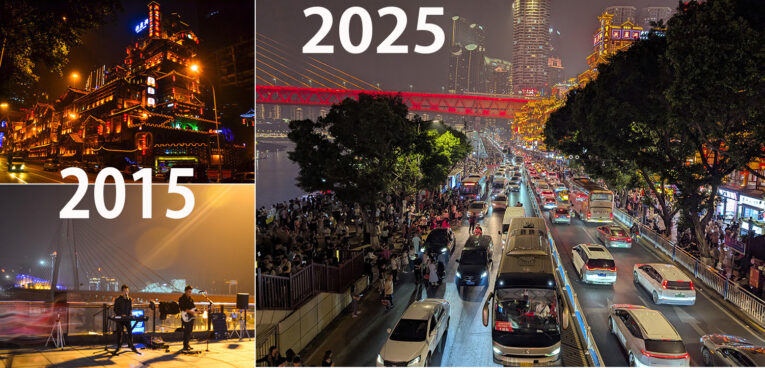
1. The High Speed Trains
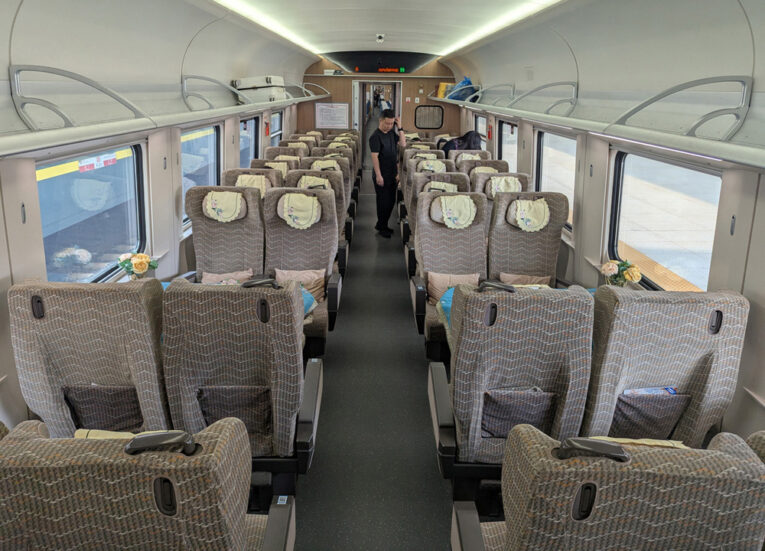
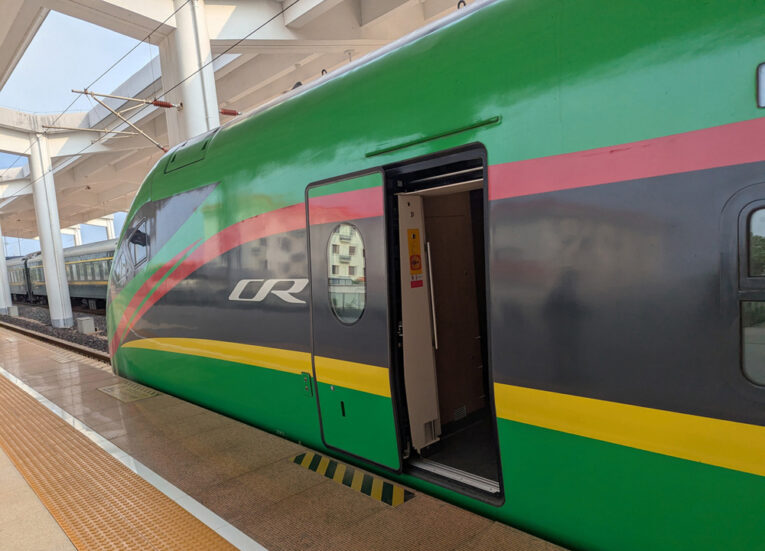
Similar again to Japan, China’s impressively fast and efficient high-speed trains (because who doesn’t love trains?) is much like Japan’s JR system. A sleek, efficient high-speed rail network that connects nearly every major tourist destination. In fact China has the World’s Largest High-Speed Rail Network: Over 45,000 km (28,000 miles) of track as of 2025 — more than the rest of the world combined.
This even includes surrounding regions as China links to wider Asia and one of our recent visit was travelling overland from Laos via the high-speed Laos-China Railway. This was part of a longer overland journey from Bangkok to China by train. A route from Bangkok which will also/eventually be connected by China’s High Speed trains.

2. Diverse Landscapes
One of the wildest things about travelling in China is how fast the scenery—and weather—can change. One day you’re in a t-shirt, the next you’re in snow-covered Shangri-La. My recent land crossing from Laos into Yunnan is a perfect example of this contrast. The trip takes around 10 hours on high-speed trains, yet the difference in climate, culture, and scenery feels like stepping into a whole other world. And that’s just within one of China’s 23 provinces.
China is massive—we’re talking a country that spans 5 time zones, borders 14 countries, and is roughly five times the size of Southeast Asia. It’s on the scale of an entire continent, like Europe. And while it doesn’t have the beachy vibe that Southeast Asia offers (except maybe Hainan), that’s exactly the kind of escape I’m looking for after living in Thailand. Personally, I’m drawn more to places like Tibet, the Himalayas, or the Harbin Snow Festival—there’s just an endless amount of China to explore.



3. Seamless Travel Apps
Travelling in China used to be a serious challenge. Back in the day, we didn’t have proper smartphones, Google and social media were blocked, and we had to rely on printed paper for everything. It made for a rewarding experience in its own way, but wow—things have changed. These days, travel feels effortless, all thanks to a few must-have mobile apps.
Now, we land in any city and Metro Man helps us figure out the best subway route straight to our hotel. Once we’re in the area, Amap (China’s answer to Google Maps) takes over, guiding us the rest of the way. And if we’re not in the mood to walk, we just book a ride with Didi, China’s version of Uber. Everything is paid with AliPay, and we barely touch cash anymore. On our last trip, we only carried some Yuan for emergencies—which ended up being spent on snacks at the airport before heading home.
At the hotel, we just message the front desk via WeChat, and use its built-in translation feature to handle any language barriers. Most eSIMs come with a built-in VPN too, so we still get access to Google services like Translate, which is super handy. They’re also dirt cheap, so we just go for a 100GB daily data plan to easily back up photos and videos to Google Photos along the way.


4. Silly Cheap (Amazing Value) Travel
I started writing this while on an 8-hour high-speed train ride from Kunming to Chengdu. The ticket? Just £35 for a 661 km journey—pretty wild value. The night before, I stayed in a hotel that cost only £17.95, and it came with some seriously cool features: an AI butler, smart controls for the TV projector, curtains, blinds, air-con, and even a Japanese robotoilet. The room had soft, fluffy bedding, compressed marble finishes, and came stocked with complimentary essentials like a toothbrush, comb, slippers, and more. All that—for under £18.
Travel across China is undeniably cheap, but I prefer to call it amazing value, because it’s far from low quality. In fact, we ended up ditching public transport at times simply because Didi rideshares were so affordable. I took an average of five trips around Chengdu, and it worked out at just 1.65 Yuan (around £0.17) per km. When compared with the Grab app in Bangkok, Didi was 41% cheaper.
One of the best examples? The 20 km ride to Chongqing Airport cost just 30 Yuan (£3.11)—and in a smooth, quiet electric vehicle with barely any traffic. That’s China for you: efficient, modern, and seriously great value.



5. Massive Megalopolises
Ever heard of Chongqing? With a staggering population of 32 million, it holds the title of largest city in the world—at the administrative level. That’s six times the population of Bangkok! Though to be fair, urban density tells a different story, with Bangkok being nearly four times more densely populated than Chongqing.
But Chongqing is just the beginning. China is home to an incredible number of vast, sprawling megacities—each with populations over 10 million. These are not the kind of places you can breeze through in a day or two; each one could easily take weeks to explore.
Right now, China has 18 official megacities:
Chongqing, Shanghai, Beijing, Chengdu, Guangzhou, Shenzhen, Wuhan, Tianjin, Xi’an, Suzhou, Zhengzhou, Hangzhou, Shijiazhuang, Linyi, Dongguan, Qingdao, Changsha, and Hefei.
All of them are in mainland China, which makes Hong Kong (7.5 million) and Macau (0.7 million) feel almost tiny by comparison.

6. Cyberpunk Cityscapes
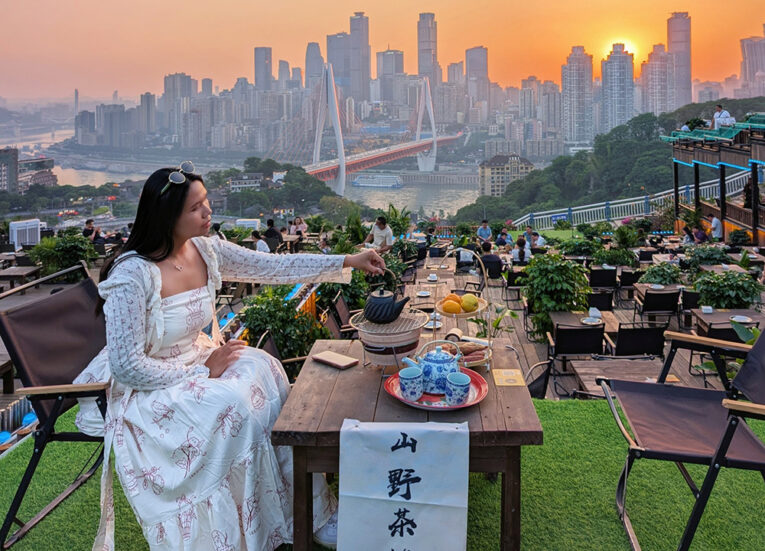
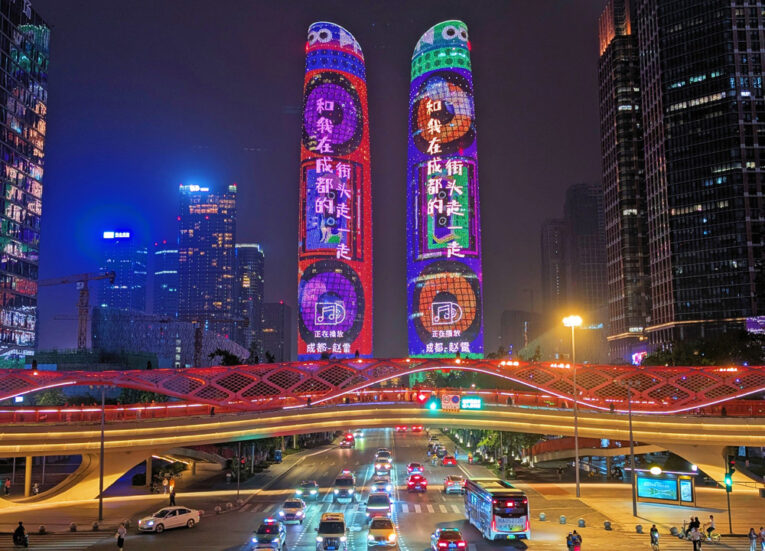
When people talk about cyberpunk—a blend of “high tech and low life”—China might not be the first place that comes to mind. But honestly, the aesthetic fits surprisingly well, though it leans more toward the high-tech, clean, and organised side. Think: massive corporate skyscrapers looming above high-rise apartments, with the occasional ancient temple tucked into the background. Add in a constant stream of electric vehicles, taxis, rideshares, and delivery bikes, and the scene feels lifted from a sci-fi film.
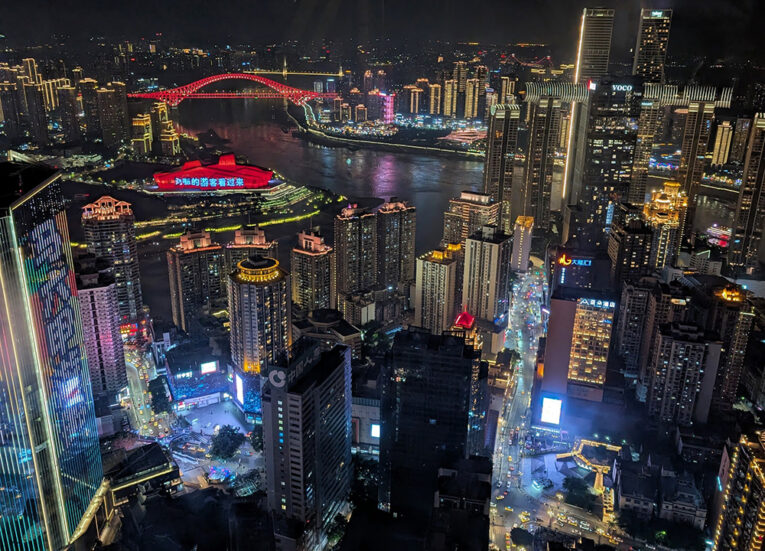
But it’s at night when the cyberpunk vibe really hits. That’s when these modern Chinese megacities glow—with neon lights bouncing off glass towers, casting surreal colours across the skyline.
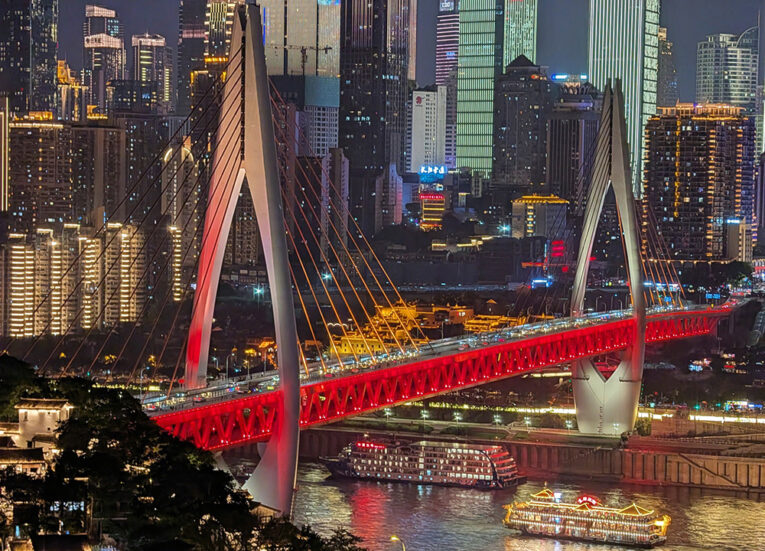
Take Chongqing for example (pictured below). We stayed in a 64th-floor hotel suite overlooking the Yangtze River—and it cost just £47 a night. That now makes it the highest hotel we’ve stayed in, topping even the Marriott Miyako in Osaka, which sits on the 53rd floor and holds the title of Japan’s highest hotel.
From our window, we looked out over a city blanketed in hazy river humidity, surrounded by misty mountains. Skywalks connect towers, monorails slice through apartment blocks, gliding over the Jialing River and across the iconic brick-red Qiansimen Bridge. Down on the streets, the experience is just as wild—we dive into spicy hotpots, sizzling BBQs, and a sensory storm of sound, smell, and light.

7. Reimagined Old Towns
Back to our Yunnan adventures, where we found ourselves in yet another ridiculously affordable hotel—this time overlooking the Old City of Lijiang (UNESCO), framed by the breathtaking Jade Dragon Snow Mountain (another UNESCO World Heritage Site). Right across from us lay a view of cobblestone streets, ornate wooden houses, and the traditional Naxi architecture that defines Lijiang Old Town.
Wander through, and you’ll see tourists dressed in traditional Naxi and Tibetan attire, snapping photos by ancient bridges and enjoying steaming hotpots of yak meat and mushrooms along peaceful canal-side restaurants.
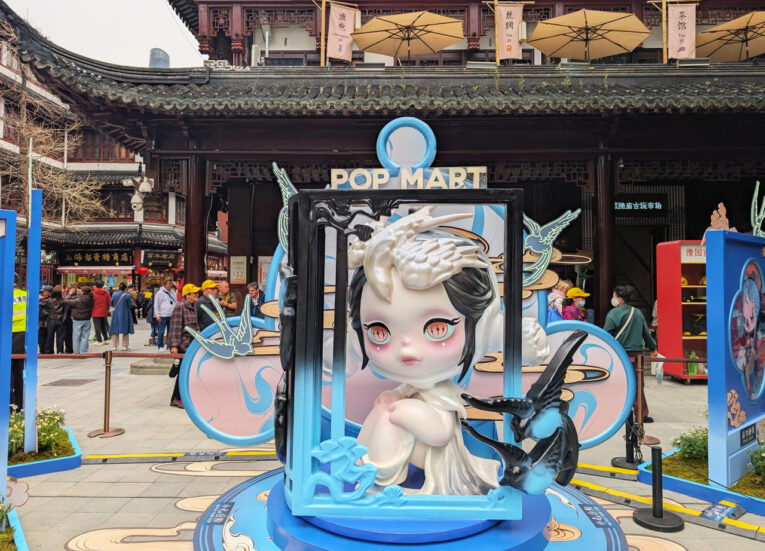
And it’s not just in Lijiang. The same heritage-meets-modern aesthetic shows up in old town districts of major cities too. Take Yuyuan Old Street in Shanghai, for example. Once a bustling hub during the Ming and Qing Dynasties, it’s now transformed into a vibrant crossroads of history and pop culture. You’ll find century-old teahouses next to trendy bubble tea spots, and lantern-lit courtyards paired with light shows and cultural exhibits in traditional shophouses.
Sure, these places are tailored for tourists and the younger generation, but when you’re new to China, they’re genuinely fascinating, offering an easy gateway into the country’s rich heritage.


8. Soft Power!
The global landscape has taken a turn in 2025, with the US now grouped alongside Russia as a global villain. The shift has been so dramatic that, during recent trade tensions, much of the world was actually rooting for China over the US.
But rather than matching aggression with aggression, China has doubled down on soft power—rebranding itself as the friendly, bargain-loving, panda-hugging nation that’s not only easier to engage with, but also kind of adorable. This softer image has spilled over into tourism, global marketing, and China’s overall public identity.
Now, let’s be honest: Chinese tourists didn’t always have the best reputation—especially in places like Thailand, where the sudden boom of middle-class package tours led to crowds and complaints. But these days? That’s changed a lot.
Thanks to efforts like the government’s “Guide to Civilized Tourism and Travel”, the once-common complaints have faded. These days, the blame seems to have shifted—to Indians in Pattaya, Russians in Phuket, and even Israelis in Pai. The loud tourist spotlight has officially moved on.
And then there’s the branding. Panda, panda, panda! What’s cuter than a panda? A panda dressed as a red panda, apparently. China’s cuteness campaign is absolutely working—just look at MINISO stores everywhere or the viral success of Pop Mart’s Labubu figures. Yes, I admit I’m a little ashamed to know what a Labubu even is… but hey, China’s soft power strategy is clearly effective.


9. Near No-One Speaks English
After five visits to China, our Mandarin still doesn’t stretch beyond a simple “nihao” and “xiexie.” Rude? I’d argue not. We come prepared, equipped with apps that handle pretty much everything—from booking hotels to ordering food. We don’t rely on others, and our interactions are mostly transactional: airports, hotels, rideshares, snacks, restaurants—all sorted with a few taps. “Nihao!” “Xiexie!” And done.
Otherwise, what’s ruder is turning up and expecting locals to speak English.Of course, kudos to anyone who actually learns the language. But in the four days before I last arrived in China, I’d already hopped through Brunei (Malay), Thailand (Thai), and Laos (Lao)—that’s a different language per day.
And truthfully? I kind of prefer not knowing the language. It adds to the culture shock, to that feeling of being immersed in the unfamiliar. I don’t want a perfect translation—I want to feel a little lost. That disorientation is what has always drawn me to travel.
It’s the moment things become too easy or too familiar that I start to lose interest—in both the destination and in travelling itself.But hey, to each their own.



10. Its All About the Food
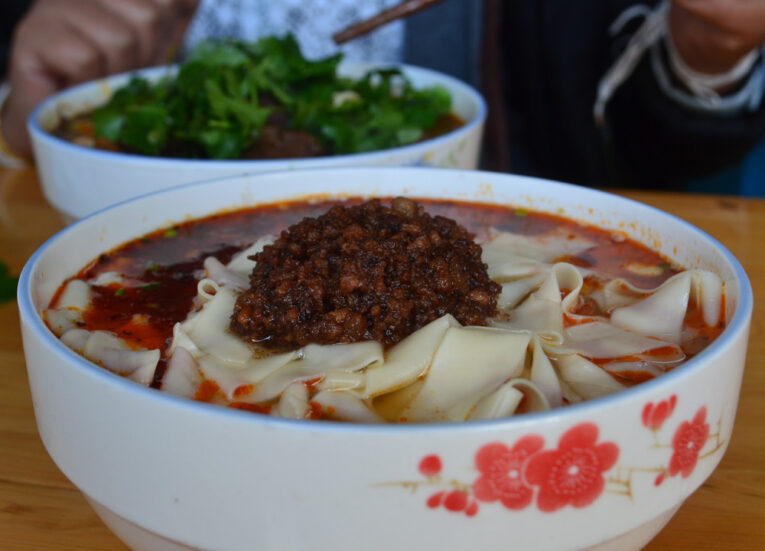
It’s not often that we return to a destination and find the food to be even better than we remember. Usually, it goes the other way. But on our latest trip back to Chongqing and Sichuan Province, we experienced some of the best food we’ve had—ever. Especially in Chengdu.
We stuck to eating local, everyday meals, and actually used TripAdvisor and Lonely Planet as guides for what to avoid. The same goes for the big-name chains like Haidilao—not because they’re bad, but because there’s just too much incredible food out there that’s still undocumented on Google or English-language food blogs.
I’ve always been a fan of Chinese cuisine in general (we even made a street food guide back in our earlier visits), but our real obsession lies with Sichuan cuisine—particularly the fiery, numbing mala flavours that define this region.
In the West, it’s often referred to as Szechuan food, but honestly, the version abroad doesn’t come close to the bold, original dishes of Chongqing and Sichuan. I’ve tried—and mostly failed—to recreate hot pot at home ever since my first experience in Chongqing.
These days, Sichuan cuisine is probably the most widespread regional Chinese cuisine across China, and increasingly across Southeast Asia too. In my book, it’s right up there with Thai food as the best in the world.


Thanks so much for sharing all this info. Heading to China soon for 1st time in our 70s and found your blog very reassuring.
Pleasure. Been following a friend of mine travelling with a (very) elderly parent. Easily getting around using hi-speed trains and Didi rideshare. 70s a fairly young age these days 🙂