
Contents
We kind of stumbled on Lourdes by accident when looking for a halfway point between our ferry arrival in Bilbao and the Camargue. It was little more than a road trip stopover. A point on a map. It wasn’t until we left our hotel that we found ourselves surrounded by pilgrims, priests, and nuns wearing traditional habits, robes or pilgrimage attire. FanFan thought it was like some Comic-Con convention. “Why are they in fancy dress?” A Comic-Con for Christians. Being from Thailand this was all very new to her.
For a destination so far off the traditional tourist map, it is one of the most touristy places I’ve been. Although the tourism here is very specific to Catholics on pilgrimage from all over the world. The Sanctuary alone attracts millions every year (almost 4 million visitors and pilgrims in 2025), with groups and clergy arriving from across Africa, Asia, the Americas and Europe. All with their own unique mix of languages, banners and attire. The Lourdes Torchlight Procession alone draws thousands of pilgrims every night.
Lourdes Beyond the Pilgrimage
Beyond the religious sites, Lourdes is actually a brilliant wee tourist town in its own right. It sits at the foothills of the Pyrenees with an almost alpine feel, surrounded by wooded hills, mountain scenery and the Gave de Pau river running through the valley.
The Pilgrimage Quarter has a particularly striking setting, with the basilicas and Grotto on one side and the river rushing past on the other. There are also lots of restaurants, from traditional French brasseries to a surprisingly wide range of international eats catering to the global crowds passing through. There’s even a wee tourist train giving tours of the area.
The Pilgrimage Quarter (Quartier des Sanctuaires)
I went into a supermarket to buy snacks and drinks but there was none. Instead, the entire “supermarket” was basically a shrine to monastic souvenirs and religious trinkets. When I gave up and tried to leave, I was cut off by a tour group swarming in through the front and had to find a back door out. The pilgrimage quarter is packed with religious shops, souvenirs and trinkets, most tied to the Virgin Mary and the story behind Lourdes. More or less, a local teenage girl, Bernadette Soubirous, said she witnessed the Virgin Mary at the nearby Grotto of Massabielle, and this is where the pilgrimage began. The grotto, spring water, candles, rosaries and images of Our Lady of Lourdes all stem from these apparitions, so pretty much every shop around the sanctuary has some version of the story for sale.
The Sanctuary of Our Lady of Lourdes
The centre of Lourdes is the Sanctuary of Our Lady of Lourdes, dominated by the Basilica of the Immaculate Conception overlooking the Grotto of Massabielle. It’s a properly impressive setting, with the basilica rising above the huge open pilgrimage grounds below, and even if you’re not religious it’s hard not to be taken in by the scale of the place. There are actually several churches and basilicas within the sanctuary, but this is the one that immediately looks and feels like the centrepiece.
The Marian Torchlight Procession
The Marian Torchlight Procession in Lourdes is one of the main nightly events, beginning at 9:00pm near the Grotto of Massabielle before making its way through the Sanctuary and eventually returning towards the Basilica. Thousands can take part, carrying candles, banners and religious standards as they walk.
The official Sanctuary website asks people who want to take part in the procession to meet at 8:30pm on the Rosary esplanade, ahead of the 9:00pm start. That probably makes sense if you are joining in. As a tourist simply there to watch, though, I would have been better turning up later.
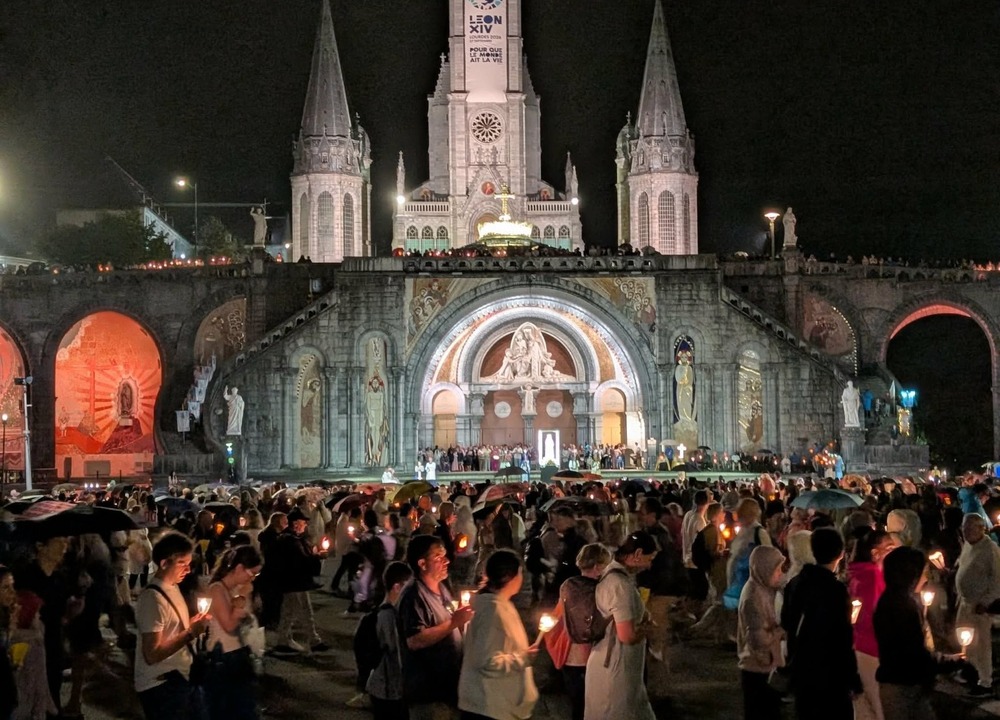
I was already at the Sanctuary by 8:45pm on a drizzly September evening, standing near the Basilica with a small crowd waiting around the front. Many were holding Lourdes candles inside paper wind shields, presumably picked up from the endless religious shops on the walk down through the Pilgrimage Quarter. Prayers and announcements came over the loudspeakers in Italian, Spanish and French, but surprisingly I heard very little English. Between them came hymns and repeated choruses of Ave Maria — “Hail Mary” in Latin, and especially fitting at Lourdes given the whole pilgrimage centres on the Virgin Mary — while most of the procession itself was still somewhere in the distance.
The Gathering at the Basilica
The procession starts on the far side of the Sanctuary and follows the long promenade before turning back towards the Basilica. For quite a while it felt less like I was watching a procession and more like I was waiting for one to arrive. By around 9:20pm the first groups were beginning to reach us, with the rest stretching away behind them in a long trail of candles.
Over the next 20–30 minutes the whole place gradually came to life. Pilgrims, priests, nuns and religious orders filled the promenade, carrying banners and singing or praying as they moved. Near the Basilica they began winding almost snakelike from left to right across the esplanade before finally gathering together in front.
By around 9:45pm the quiet, rainy square I had been standing in an hour earlier had completely transformed.
From a tourist point of view, the best time to watch the Lourdes Torchlight Procession was that final half hour. Unless you are actually joining the procession, I’d probably arrive around 9:15pm rather than 8:30pm. That would still give you time to see the procession approaching before the main gathering in front of the Basilica.
Lourdes Torchlight Procession for Tourists: FAQs
What time does the Lourdes Torchlight Procession start?
At the time of our visit, the procession started at 9:00pm. The official Sanctuary website currently lists the Torchlight Procession at 9:00pm daily from April to November, although it is worth checking the current timetable before visiting.
Why does the official website say 8:30pm?
The 8:30pm time is for people who want to take part in the procession, with the Sanctuary asking participants to meet on the Rosary esplanade before the 9:00pm start. If you’re only there to watch, you don’t necessarily need to be there that early.
What time should tourists arrive?
Based on our visit, I’d aim for around 9:15pm if you mainly want to watch the procession arrive and gather in front of the Basilica. The first groups began reaching us around 9:20pm and the main gathering had transformed the square by roughly 9:45pm.
Can tourists watch without joining the procession?
Yes. We watched from near the Basilica rather than joining the procession itself. From there you can see the groups approach, wind across the esplanade and gather in front of the Basilica.
Is the Lourdes Torchlight Procession free?
Yes. The official Sanctuary lists the procession as free to access.