Contents
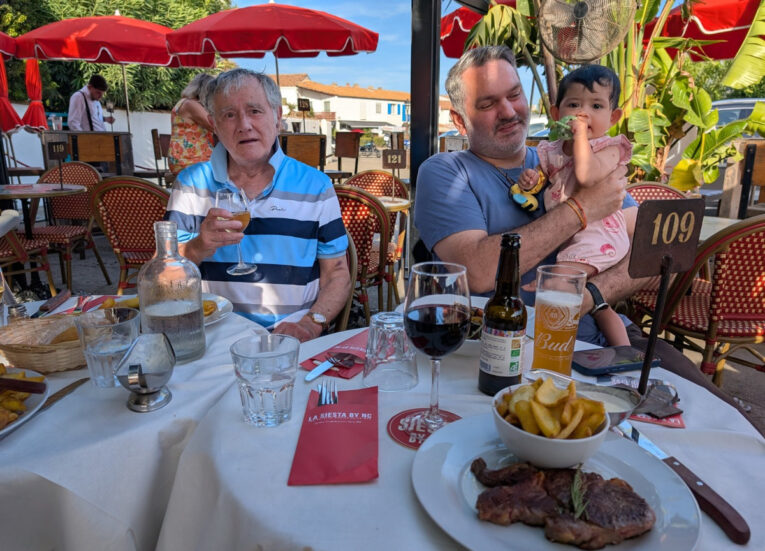
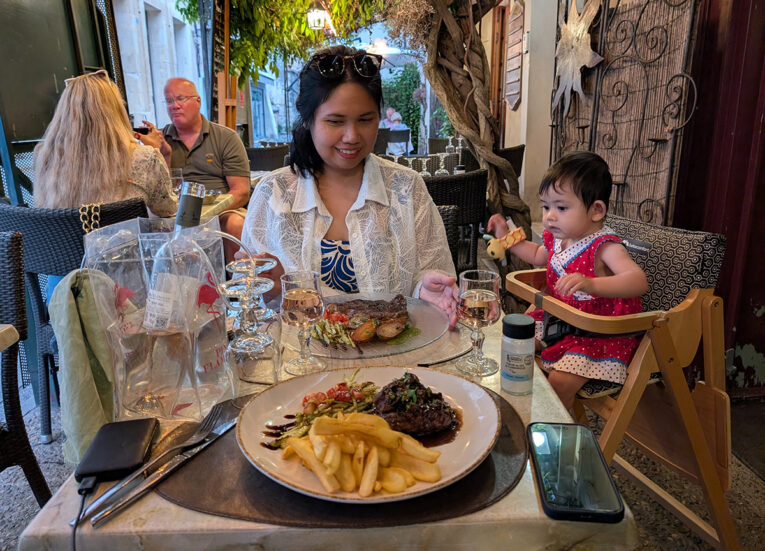
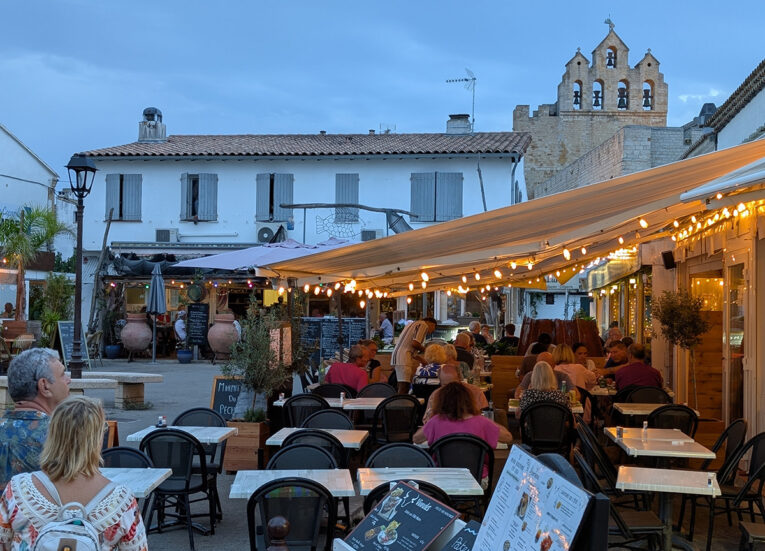
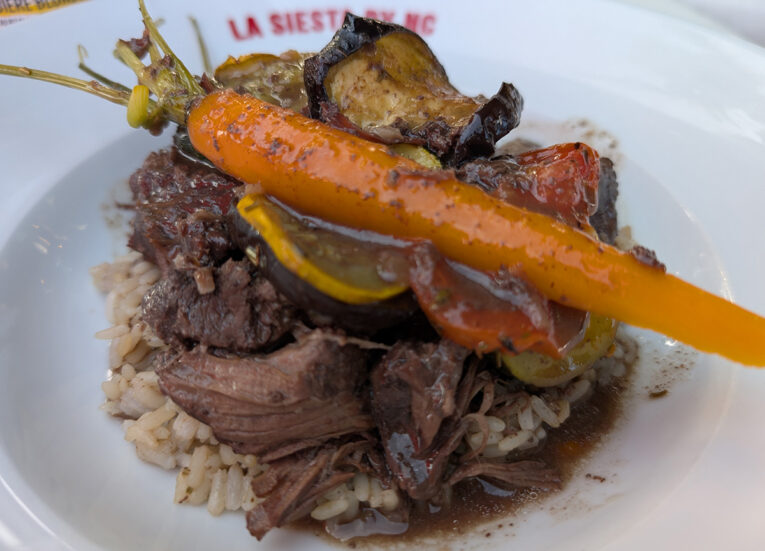
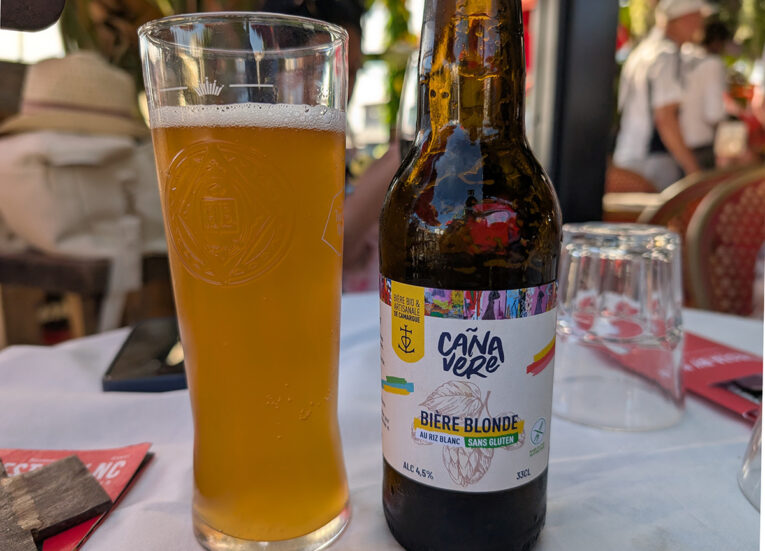
My first proper meal in the Camargue was in Saintes-Maries-de-la-Mer, the capital of the region, eating along the main seafront, Avenue Van Gogh, just down from the Arènes des Saintes-Maries-de-la-Mer, the town’s bullring. I ordered Gardiane de Taureau, traditional slow-cooked AOP (Appellation d’Origine Protégée) Camargue bull, served with Camargue rice and roasted Provençal vegetables, alongside a Caña Vère Bière Blonde au Riz Blanc de Camargue, an organic blonde beer brewed with white Camargue IGP (Indication Géographique Protégée) rice.
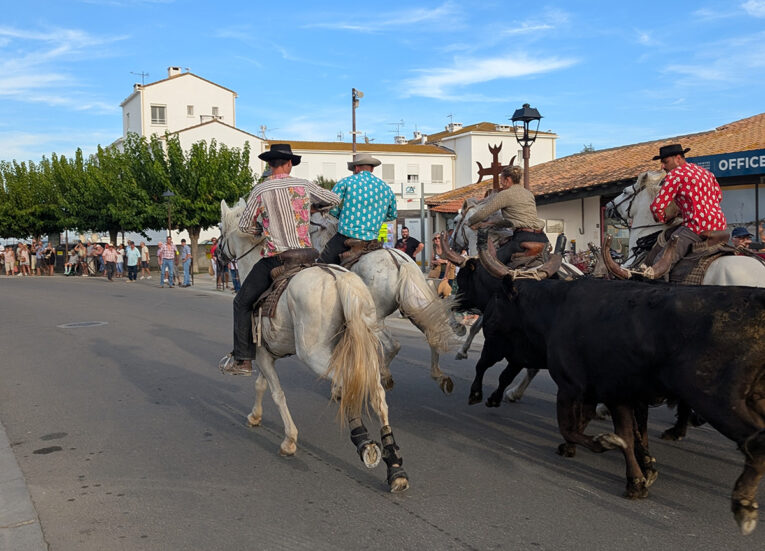
I was unaware that the arena had hosted a Course de Taù that afternoon, a traditional Camargue competition involving young bulls and gardians, the traditional Camargue cattlemen who herd the region’s famous black bulls on white Camargue horses. At around 7 PM, there was then a frenzy outside when the gardians sped along Avenue Van Gogh, in what is called a bandido, escorting the black bulls through town from the arena following the event.
If proof was needed that traditional food in the Camargue is inseparable from the culture and landscape of the region, it just galloped past my plate.

Where to Find Traditional Food in the Camargue
Finding traditional Camargue food was surprisingly easy. Almost every restaurant menu seemed to have the same local staples — tellines, Camargue bull, local rice and wines — while the more artisan food shops and Provençal markets were packed with regional produce. We kept a note of the market days during our stay, with markets in Saintes-Maries-de-la-Mer on Monday and Friday mornings and Aigues-Mortes on Wednesday and Sunday mornings.
For a wider and often more affordable selection, the local supermarkets were even better. The Intermarché Express in Saintes-Maries-de-la-Mer became a regular stop for local rice, wines, salt and prepared foods, while the larger Intermarché, Super U and Lidl on the outskirts of Aigues-Mortes seemed to have everything. I always find foreign supermarkets fascinating anyway, and here entire shelves were given over to produce from the Camargue.
So there wasn’t much of a hunt involved. The more interesting part was going looking for where it all actually came from — the rice fields, sandy vineyards, salt pans, Mediterranean beaches and manades scattered across the Camargue.

1. Camargue Bull (Taureau de Camargue)
If there is one dish I would recommend eating in the Camargue above everything else, it is Gardiane de Taureau. This is the region’s traditional bull stew, with chunks of Camargue bull slowly cooked in red wine with onions and herbs until the meat is tender and the sauce is thick and dark. It is traditionally served with Camargue rice, which soaks up all that sauce, and was easily my favourite meal of the trip.
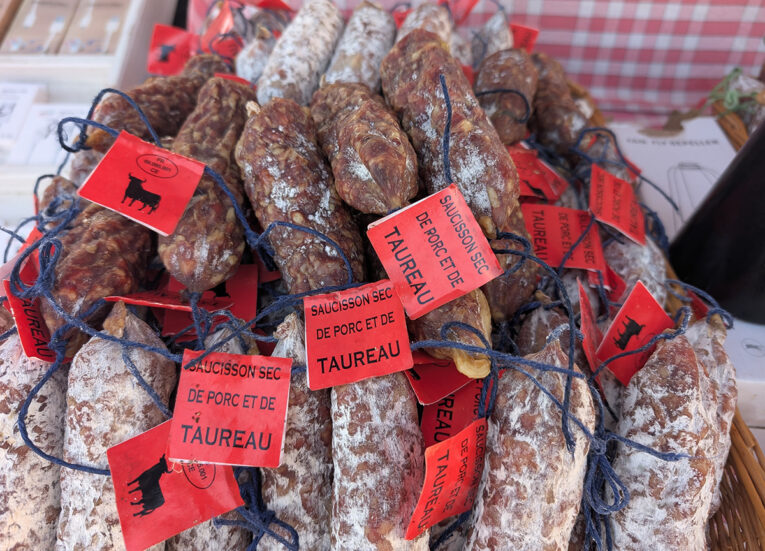
I also tried Camargue bull as a steak, but the meat is naturally leaner than the beef normally used for an entrecôte and mine was noticeably tougher. For me, the slow-cooked gardiane is where it really works. Bull appears in plenty of other forms around the Camargue as well, from steaks and burgers to sausages, saucisson, terrines and pâtés, so it isn’t difficult to find. But if you’re only eating it once, make it Gardiane de Taureau with Camargue rice.
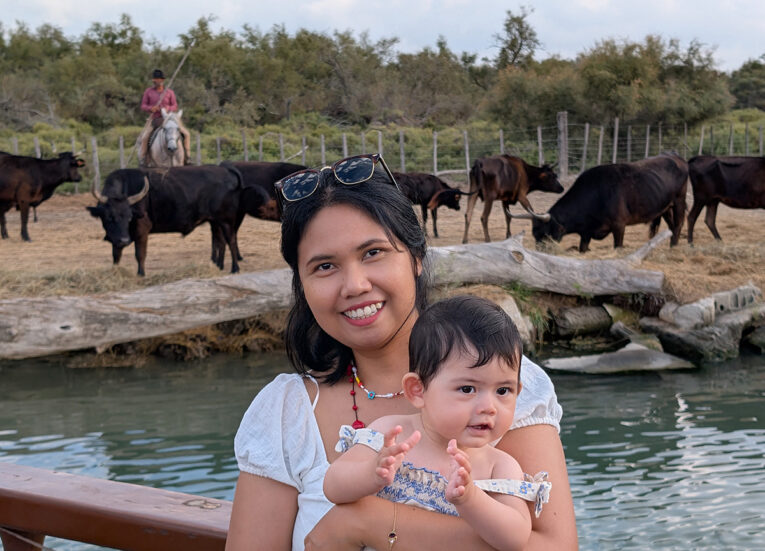
The black bulls are raised outdoors in herds known as manades, roaming the Camargue under the watch of gardians, the traditional cattlemen on their white Camargue horses. Taureau de Camargue has protected AOP (Appellation d’Origine Protégée) status and the animals live outdoors year-round, producing a distinctive dark, lean meat with very little fat. It’s another example of Camargue cuisine tied directly to the landscape — from the manades to the plate.

2. Vin des Sables and Gris de Gris
One of the quirks of Camargue wine is that the vines grow in the sandy soils of the Rhône delta, hence Vin des Sables — wines of the sands. The sand is such a defining feature that Sable de Camargue AOP (Appellation d’Origine Protégée) vineyards require soils dominated by sand.
The wine I was particularly looking for was Gris de Gris, made from Grenache Gris grapes. Despite the name, the grapes aren’t actually grey, but pinkish-grey to reddish. They’re pressed with minimal skin contact, producing the incredibly pale wine characteristic of the Camargue.
Camargue wines were everywhere, although Gris de Gris proved surprisingly difficult to find. Our local Intermarché Express had just one option, from Domaine de Montcalm, a vineyard we regularly passed between Saintes-Maries-de-la-Mer and Aigues-Mortes. So I hopped out for a look at the grapes growing amongst the sands.
We also considered the vineyard train at Domaine Royal de Jarras, but tours were by appointment and I suck at planning.


3. Camargue Rice (Riz de Camargue)
The Camargue is the heart of rice production in France, with the vast majority of French-grown rice coming from the Rhône delta. Riz de Camargue has protected IGP (Indication Géographique Protégée) status and comes in white, brown, red and black varieties. Its most obvious appearance in traditional Camargue cuisine is alongside Gardiane de Taureau, but it also turns up in risottos and paellas, rice cakes and crackers, and even local beers.
I washed down my first Gardiane with a Caña Vère blonde brewed using white Camargue IGP (Indication Géographique Protégée) rice, while they also produce a beer using the local red rice.
We brought our own rice cooker to the cabin, an essential piece of travel kit when you have an Asian wife, so naturally we bought bags of local rice to cook ourselves. The white Camargue rice was surprisingly familiar and reminded us a lot of the jasmine rice we normally eat, both in texture and aroma.
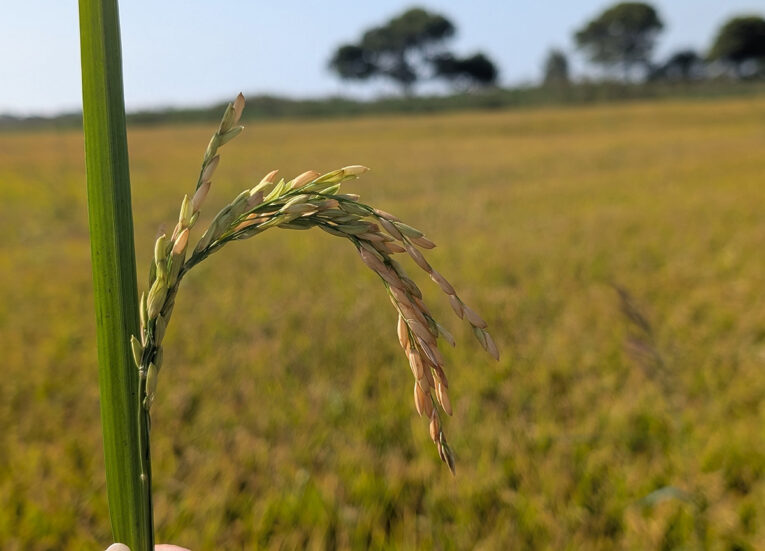
The rice fields of the Camargue are another distinctive part of the landscape. Rather than the terraced paddies normally associated with Asia, the rice is grown across the flat Rhône delta, irrigated with fresh water from the Rhône in a landscape otherwise heavily influenced by salt. We passed fields of golden rice throughout the trip, so like the bulls, wine and salt, it was easy to follow another Camargue food from the fields right through to the plate.

4. Tellines: Camargue Shellfish
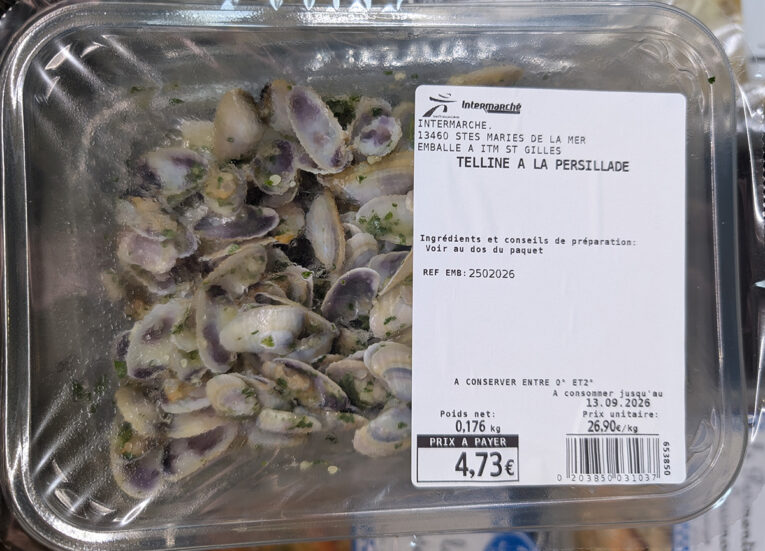
I only dared myself to try moules-frites a few days earlier in Marseille. I liked them, but I still didn’t want to go all-in on tellines, the tiny shellfish found along the sandy Mediterranean coast of the Camargue. I figured a cheap portion from the local Intermarché Express was a safe start. If I hated them, I hadn’t lost much.
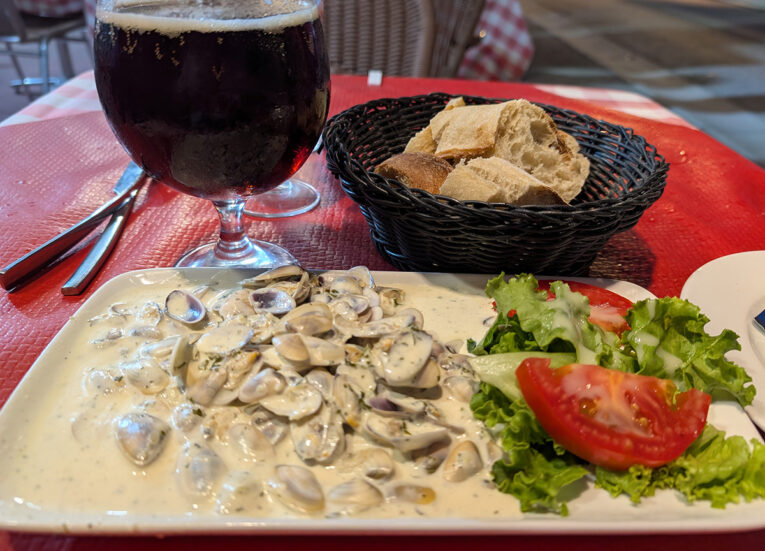
Instead, I checked the restaurants along Avenue Frédéric Mistral in Saintes-Maries-de-la-Mer for tellines and found a plate for €12, so I went to town. I ordered a big Kronenbourg with Picon alongside them — an everyday French lager with a bitter orange aperitif, better known as a working-man’s drink in northern and eastern France.
I ate the lot and schlopped up the sauce. They’re not exactly delicious, but they’re a bit like pistachios in shell shape and size — once you start eating them, it’s hard to stop. They’re messy and fiddly, so fingers are definitely the way to go.
They’re not very filling, but you’re left with an awesome garlicky persillade sauce to schlop up with bread.
To track Camargue tellines back to their source I headed to Plage Est, one of the main harvesting spots alongside Beauduc and Piémanson. Telliniers wade into the shallows and walk backwards, dragging a small rake-net through the sand where the tellines are buried. Unfortunately they generally work in the morning and I arrived too late. I’m far too lazy to get up that early anyway.

5. Camargue Salt (Sel de Camargue)
I obviously don’t expect you to munch down a plate of Camargue salt but, culturally, it’s important, and it’s a big part of Camargue cuisine.
Camargue salt seasons everything from bull and seafood to rice and vegetables, while Fleur de Sel de Camargue regularly appears on restaurant tables. You’ll also find bags and jars flavoured with herbes de Provence, garlic and chilli and other seasonings in shops throughout the region, so you’ll probably experience Camargue salt without even thinking about it.
Fleur de Sel de Camargue literally means “flower of salt” and is the good stuff. During the hot summer months, fine crystals form on the surface of the salt ponds and are traditionally skimmed by hand by the sauniers, or salt workers. Unlike ordinary cooking salt, it stays slightly moist and crunchy and is normally sprinkled over food as a finishing salt. Fleur de Sel de Camargue has protected IGP (Indication Géographique Protégée) status.
We went straight to the source at the Salins d’Aigues-Mortes, where a little tourist train runs through the enormous salt marshes and their surreal pink lakes. The colour comes from salt-loving microorganisms in the water, the same food chain that helps give Camargue flamingos their pink colour. The tour passes huge white mountains of harvested salt and explains the production process, with the famous La Baleine salt brand produced at Aigues-Mortes — the little blue whale that has appeared on French kitchen tables for generations.


Traditional Camargue Food: From Landscape to Plate
What I liked most about eating in the Camargue was how easy it was to connect the local food to the landscape around us. Bulls grazing in the manades, rice fields across the Rhône delta, vines growing in sand, tellines beneath the Mediterranean shallows and salt crystallising around Aigues-Mortes all ended up on the same menus. For a region best known for flamingos, white horses and wetlands, the food of the Camargue turned out to be just as distinctive.